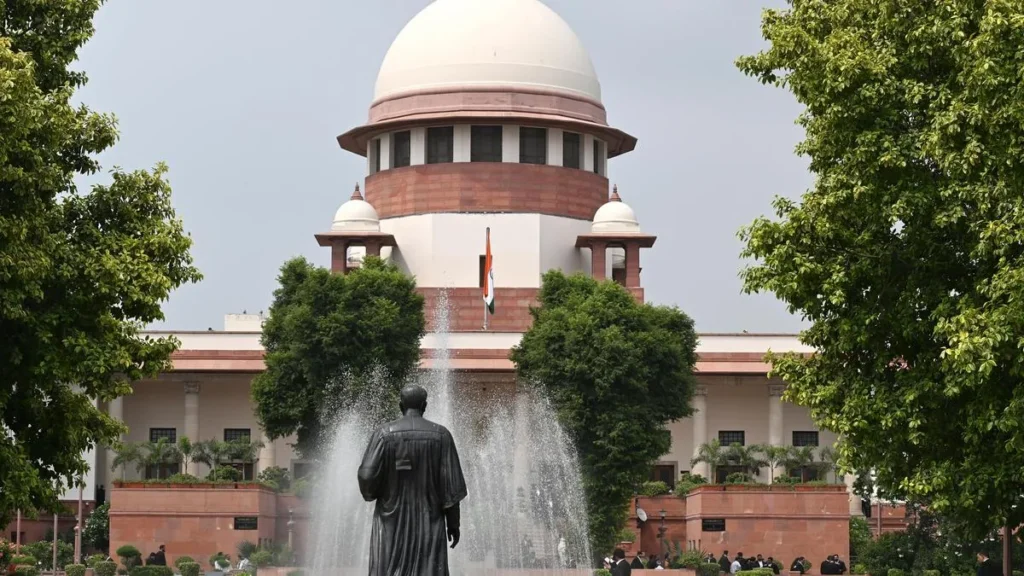
NEW DELHI — The Supreme Court on Wednesday stayed an order issued by the Allahabad High Court directing the recovery of ₹5 lakh from the salary of Noida District Magistrate Medha Roopam in connection with the detention of student Akriti Chaudhary under the National Security Act (NSA). The apex court’s intervention halts the immediate financial penalty while the legal dispute over the validity of the detention and the subsequent compensation claim proceeds to a final hearing.
The stay order was issued by a bench of the Supreme Court while hearing a special leave petition filed by the Union of India and the Noida administration. The petition challenged the Allahabad High Court’s earlier judgment, which had quashed Chaudhary’s NSA detention and directed the state government to compensate the petitioner by recovering the amount from the DM’s personal salary.
High Court’s earlier ruling
In its original order, the Allahabad High Court had examined the grounds for Chaudhary’s detention. The court found that the detention order issued by the Noida administration did not meet the statutory requirements under the NSA, specifically regarding the satisfaction of the detaining authority. The High Court noted that the grounds cited for detention were vague and did not establish a clear threat to public order or national security as mandated by the statute.
Consequently, the High Court quashed the detention order and directed the state government to pay compensation to Chaudhary. Unusually, the High Court specified that the compensation of ₹5 lakh should be recovered from the salary of DM Medha Roopam, citing her role as the detaining authority. The court’s order drew significant attention for its direct attribution of financial liability to the individual officer rather than the state exchequer.
Supreme Court’s intervention
The Union of India and the Noida administration argued before the Supreme Court that the High Court’s direction to recover compensation from the DM’s salary was beyond its jurisdiction and contrary to established principles of administrative law. The petitioners contended that the state government, not the individual officer, should bear the liability for compensation in cases where detention is found to be illegal. They further argued that the High Court’s order effectively penalized the officer without providing an opportunity to be heard on the specific issue of personal liability.
The Supreme Court bench, after hearing the arguments, granted the stay. The court directed that the recovery of ₹5 lakh from DM Roopam’s salary be suspended until the final disposal of the special leave petition. The bench did not pass any final order on the merits of the case but reserved its judgment for a later date.
Legal experts noted that the Supreme Court’s stay does not imply that the detention was lawful or that the compensation claim is invalid. It merely pauses the enforcement of the High Court’s specific directive regarding the source of compensation. The underlying issue of whether Chaudhary’s detention was justified under the NSA remains a matter for final adjudication.
Context of the detention
Akriti Chaudhary, a student, was detained under the NSA in Noida. The detention order cited concerns related to public order and the prevention of acts threatening national security. Chaudhary’s family and legal representatives challenged the detention, arguing that the grounds were fabricated and that the detention was an attempt to suppress dissent. The case gained prominence due to the involvement of a student and the use of the NSA, a law that allows for detention without trial for up to 12 months.
The Allahabad High Court’s initial decision to quash the detention and order compensation from the DM’s salary was seen as a strong judicial rebuke to the Noida administration’s use of the NSA. However, the Supreme Court’s stay introduces a layer of procedural complexity, as the final determination of liability and the validity of the detention will now be decided by the apex court.
DM Medha Roopam has not issued a public statement on the matter. The Noida administration, through its legal representatives, has maintained that the detention was based on credible intelligence and was in the interest of public safety. The Union of India has stated that it will defend the legality of the detention order before the Supreme Court.
The case is expected to be listed for further hearing in the coming weeks. The final outcome will have implications for the use of the NSA in similar cases and for the personal liability of administrative officers in detention matters.
Primary Sources & Official Records
- Supreme Court stays High Court order to recover ₹5 lakh from Noida DM in NSA detention cas
- Supreme Court Stays Allahabad HC Order Quashing Student’s NSA Detention & Slamming Noida D
- BREAKING: Supreme Court Stays Recovery Of ₹5 Lakh From Noida DM’s Salary In Akriti Chaudha
- Supreme Court Stays Allahabad HC Order Fining Collector For Akriti Chaudharys NSA Detentio