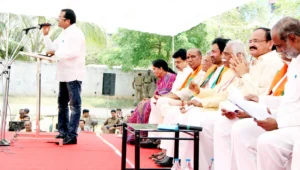
HYDERABAD — The Bharat Defence Conclave 2026 concluded in Hyderabad on Wednesday, placing indigenous technology, strategic autonomy, and the evolving nature of future warfare at the center of India’s defense discourse. The event, organized by the Confederation of Indian Industry (CII) in collaboration with the Telangana government, served as a platform for policymakers, industry leaders, and defense researchers to address the imperative of reducing reliance on foreign imports and accelerating the deployment of homegrown systems.
Startups and Strategic Autonomy
A defining feature of the 2026 conclave was the prominent participation of the defense startup ecosystem. According to reporting by The Hindu, 42 defense startups took center stage, presenting prototypes and operational systems ranging from unmanned aerial vehicles (UAVs) and electronic warfare suites to advanced materials and cyber-defense tools. The Telangana government has positioned the state as a hub for military technology, leveraging its existing IT infrastructure and research institutions to foster a defense innovation corridor. Officials noted that the conclave aimed to bridge the gap between laboratory research and field deployment, a critical bottleneck in India’s defense procurement process.
Technology as National Security
The intellectual framework of the conclave was underscored by the assertion that technology security is inextricably linked to national security. Dr. B. K. Das, a senior scientist at the Defence Research and Development Organisation (DRDO), addressed the CII TN Defence X Conclave, stating that the integrity of India’s defense supply chain and the security of its digital infrastructure are paramount in a multipolar world. He emphasized that indigenous development is not merely an economic preference but a strategic necessity to ensure that critical military systems are not subject to external geopolitical leverage. This sentiment aligned with the broader government policy of “Atmanirbhar Bharat” (Self-Reliant India), which seeks to make India a global manufacturing hub for defense equipment.
Future Warfare and Doctrine
Discussions at the conclave focused heavily on the doctrinal shifts required to address modern conflict scenarios. Panelists from the Indian Army, Navy, and Air Force, along with think tank experts, debated the integration of artificial intelligence, autonomous systems, and hypersonic technologies into operational command structures. The consensus was that future warfare will be characterized by speed, data dominance, and multi-domain operations, requiring a seamless fusion of cyber, space, and kinetic capabilities. The conclave also addressed the need for updated procurement policies that allow for faster acquisition of emerging technologies, moving away from traditional long-cycle tender processes.
Industry and Government Collaboration
The event facilitated direct interactions between defense public sector undertakings (PSUs) and private sector firms. Several Memorandums of Understanding (MoUs) were signed to collaborate on joint development projects, particularly in the areas of drone technology and satellite communications. The Ministry of Defence has been actively encouraging such partnerships to scale up production and reduce costs. Industry representatives highlighted the importance of a stable policy environment and clear intellectual property rights frameworks to attract long-term investment in defense research and development. The conclave concluded with a call for a unified national strategy that aligns industrial capacity with military requirements, ensuring that India’s defense ecosystem is resilient, innovative, and globally competitive.