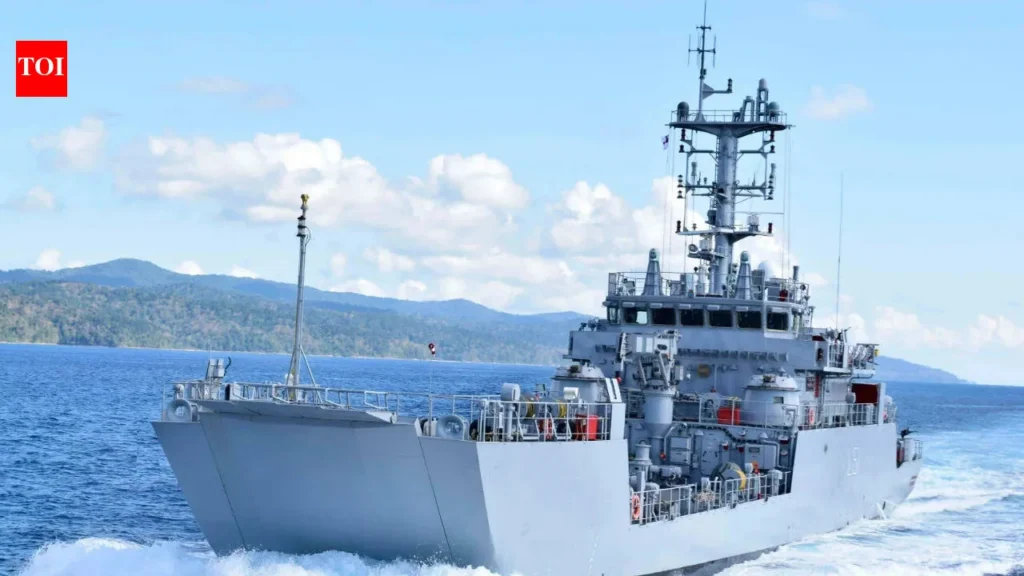
NEW DELHI — The Indian Navy has initiated the procurement process for six additional Landing Craft Utility (LCU) Mk-V platforms, issuing a Request for Information (RFI) to industry stakeholders to bolster its amphibious warfare and logistics capabilities. The move, reported by The Times of India on September 22, 2026, aligns with the Navy’s broader strategic objective to strengthen its power projection in the littoral zones of the Indian Ocean Region.
Strategic Context and Operational Requirements
The LCU Mk-V is a 1,500-tonne amphibious vessel designed to transport troops, armored vehicles, and heavy equipment from ship to shore. These platforms are critical for the Navy’s amphibious operations, which require the rapid deployment of Marine Commandos and naval infantry onto hostile or contested beaches. The new procurement is intended to replace aging assets and expand the fleet’s operational tempo, ensuring that the Navy can sustain prolonged amphibious campaigns alongside its existing fleet of LCU Mk-IV and Mk-V vessels.
Beyond combat roles, the LCU Mk-V platforms are integral to the Navy’s Humanitarian Assistance and Disaster Relief (HADR) mandate. In recent years, the Navy has increasingly utilized these vessels for evacuations, medical relief, and logistics support during natural disasters such as cyclones and earthquakes. The additional six vessels will significantly enhance the Navy’s capacity to respond to large-scale disasters, providing a robust logistical backbone for relief operations in remote coastal areas and island territories.
Procurement Process and Industry Engagement
The issuance of the RFI marks the initial phase of the procurement cycle under the Defence Acquisition Procedure (DAP). This step allows the Navy to gather technical specifications, cost estimates, and manufacturing timelines from domestic shipyards and defense manufacturers. The Navy is expected to evaluate the responses to determine the optimal mix of indigenous manufacturing and potential technology transfer, in line with the government’s ‘Atmanirbhar Bharat’ (Self-Reliant India) initiative in defense production.
Industry sources indicate that the RFI seeks detailed proposals on the vessel’s propulsion systems, armor protection, and integrated weapon systems. The LCU Mk-V is designed to operate in rough sea conditions, a critical requirement for the Navy’s operations in the Bay of Bengal and the Arabian Sea. The vessels are expected to be equipped with advanced navigation and communication systems to ensure interoperability with other naval platforms, including landing ships and destroyers.
Broader Defence Acquisition Context
This procurement is part of a larger wave of defense acquisitions approved by the Defence Acquisition Council (DAC). According to DD News, the DAC recently cleared defense acquisitions worth ₹52,000 crore to strengthen the Army, Navy, and Air Force. The LCU Mk-V procurement fits within this broader framework, which aims to modernize the tri-services’ equipment base and reduce dependence on foreign imports. The Navy’s focus on amphibious capabilities reflects a shift towards a more assertive maritime posture, capable of defending India’s extended coastline and securing its maritime trade routes.
Defense analysts note that the expansion of the LCU fleet will also support the Navy’s island defense strategy. With India’s strategic interests in the Andaman and Nicobar Islands and the Lakshadweep archipelago, the ability to rapidly deploy forces to these locations is paramount. The LCU Mk-V’s range and endurance make it suitable for sustained operations in these remote areas, where logistical support is often limited.
Technical Specifications and Capabilities
The LCU Mk-V is a multi-role vessel capable of carrying up to 100 troops or equivalent cargo. It features a ramp at the bow for vehicle embarkation and disembarkation, allowing for rapid offloading of tanks, armored personnel carriers, and artillery. The vessel is powered by a combination of diesel engines and electric motors, providing both high-speed transit and fuel-efficient cruising. Its hull design is optimized for beaching, allowing it to operate in shallow waters where larger landing ships cannot access.
The procurement of six additional vessels will bring the total number of LCU Mk-V platforms in the Navy’s inventory to a level that ensures operational redundancy and maintenance cycles. This expansion is expected to be completed within the next five to seven years, subject to the completion of the procurement process and shipbuilding timelines. The Navy has emphasized that the new vessels will be built at indigenous shipyards, creating jobs and boosting the domestic defense industry.
Primary Sources & Official Records
- Indian Navy plans to procure six more landing craft utility platforms to boost amphibious
- Indian Navy Moves to Procure Six New 1,500-Tonne LCU Mk-V Amphibious Ships – SSBCrack
- Indian Navy Issues RFI For Six 1,500-Tonne LCU Mk V Platforms To Boost Amphibious, Logisti
- DAC clears Rs 52,000 crore defence acquisitions to strengthen Army, Navy and Air Force – D