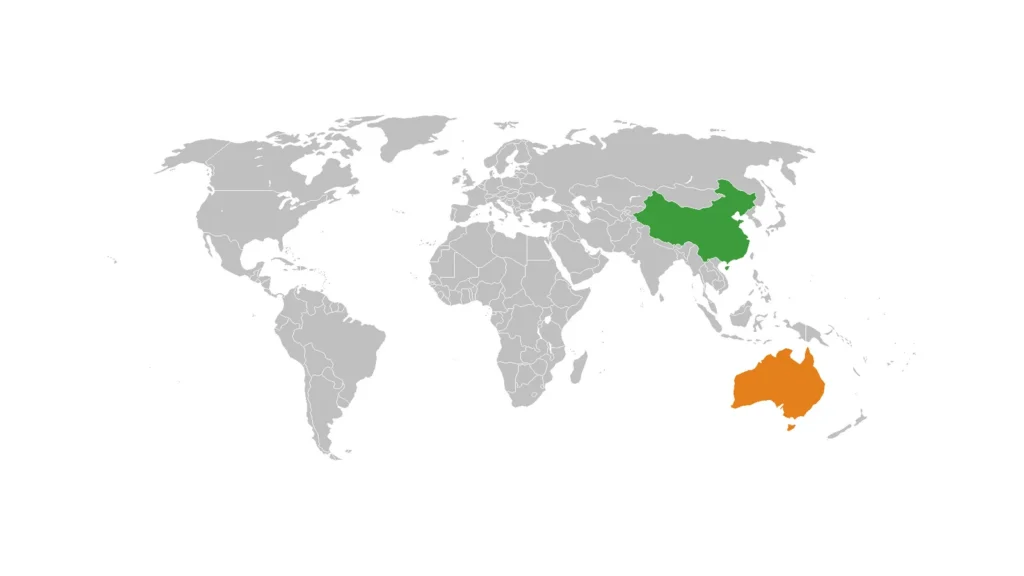
SYDNEY — Australia is navigating an increasingly complex geopolitical landscape, caught between its traditional security alliance with the United States and its heavy economic reliance on China. As tensions between the two superpowers intensify, Canberra is forced to recalibrate its foreign policy to protect national interests without alienating either major power.
The dilemma is stark: China remains Australia’s largest trading partner, accounting for a significant portion of the country’s exports, particularly in resources like iron ore, coal, and liquefied natural gas. Conversely, the United States is Australia’s most important security partner, a relationship formalized by the AUKUS trilateral pact, which includes commitments to share advanced military technologies, including nuclear-powered submarine capabilities.
Economic Vulnerability
Recent trade disruptions have highlighted Australia’s vulnerability. Beijing has imposed tariffs on Australian wine, barley, and lobster, citing anti-dumping investigations. These measures have caused substantial financial losses for Australian producers and exporters. In response, the Australian government has urged its citizens and businesses to diversify their export markets, looking toward India, Japan, and South Korea to reduce dependence on the Chinese market.
However, diversification is a long-term strategy. In the short term, the economic pain of reduced trade with China is immediate. The Australian government has stated that it will continue to engage with Beijing on trade issues, emphasizing the importance of a rules-based international trading system. Yet, critics argue that diplomatic engagement has not yielded tangible results, and that Australia needs to prepare for a prolonged period of strained relations.
Security Commitments
On the security front, Australia has deepened its ties with the United States and its allies in the Indo-Pacific region. The AUKUS agreement, signed in 2021, marks a significant shift in Australia’s defense posture. The pact includes a commitment to develop nuclear-powered submarines, a capability that has raised concerns in Beijing, which views the alliance as a direct threat to its regional influence.
China has responded to AUKUS with strong diplomatic protests, warning that the pact undermines regional stability. Despite these warnings, Australia has maintained that the alliance is defensive in nature and aimed at ensuring peace and security in the Indo-Pacific. The Australian government has also increased its defense spending, with plans to boost its military budget to 2% of GDP, in line with NATO standards.
Diplomatic Tightrope
Canberra’s diplomatic strategy involves a delicate balancing act. The government has sought to maintain open channels of communication with both Washington and Beijing, while also strengthening its relationships with other regional powers. This approach reflects a broader trend among middle powers in the Indo-Pacific, which are seeking to avoid being forced to choose sides in the US-China rivalry.
However, the margin for error is shrinking. As the US and China compete for influence in the region, Australia’s neutrality is increasingly difficult to maintain. The government has faced pressure from both sides to take a more definitive stance. US officials have urged Australia to align more closely with Washington on issues such as human rights and cybersecurity, while Chinese officials have warned against allowing foreign interference in China’s internal affairs.
Future Outlook
Looking ahead, Australia’s ability to navigate this complex environment will depend on its capacity to manage its relationships with both superpowers. The government has emphasized the importance of economic resilience and strategic autonomy, arguing that Australia must be prepared to make difficult choices in the face of geopolitical uncertainty.
Analysts suggest that Australia’s future will be shaped by its ability to balance its economic interests with its security commitments. While the country may not be able to fully decouple from either power, it can work to reduce its vulnerabilities and strengthen its position in the global order. The coming years will be a critical test of Australia’s diplomatic skills and strategic foresight.