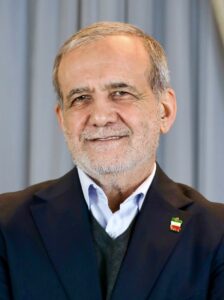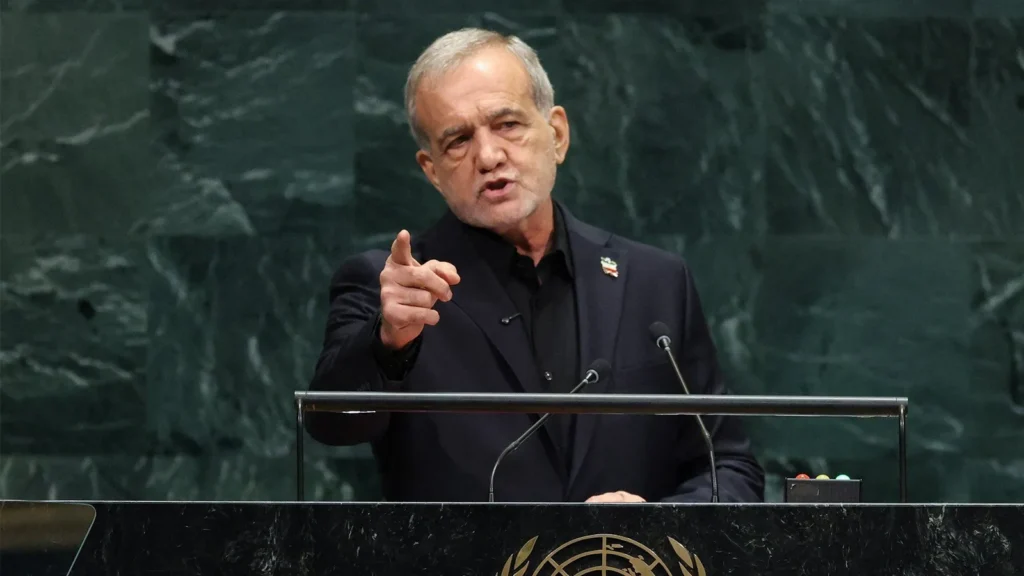
NEW YORK — Iranian President Masoud Pezeshkian delivered a confrontational address to the United Nations General Assembly on Wednesday, labeling the United States a “terrorist” state and accusing it of global bullying, even as he called for a return to diplomatic negotiations to resolve the nuclear standoff.
The speech, delivered during the high-level week of the 81st session of the UNGA, marked a sharp escalation in rhetoric from Tehran’s leadership. Pezeshkian directly challenged the administration of U.S. President Donald Trump, stating that Iran would fight “until our last breath” to defend its sovereignty against what he described as imperialist aggression.
“The United States is a terrorist state,” Pezeshkian said, addressing the assembly. “They are the victims of their own terrorism, yet they accuse others of it.” The president alleged that Washington’s foreign policy is driven by a desire for regional dominance and the suppression of independent nations, particularly in the Middle East.
Despite the hostile tone toward Washington, Pezeshkian emphasized that Iran remains committed to diplomacy. He stated that Tehran is open to negotiations regarding its nuclear program, provided that the United States lifts its sanctions and adheres to the terms of the Joint Comprehensive Plan of Action (JCPOA). “We are not seeking a nuclear weapon,” he said. “We seek our rights under international law. We seek dialogue, not conflict.”
The address comes at a critical juncture in U.S.-Iran relations. Tensions have risen significantly since the resumption of U.S. pressure on Tehran, with Washington imposing new sanctions and increasing military presence in the region. The U.S. State Department has previously characterized Iran as the “principal state sponsor of terrorism,” a designation Pezeshkian rejected in his speech.
In a separate segment of his address, Pezeshkian highlighted Iran’s domestic challenges, citing economic hardship caused by international sanctions. He urged the international community to hold the United States accountable for what he termed “economic warfare” against the Iranian people. “The suffering of the Iranian people is a direct result of U.S. policies,” he said. “The world must see through the propaganda and understand the reality on the ground.”
Reactions to the speech were swift. U.S. officials have not yet issued a formal public response to Pezeshkian’s specific accusations, though senior administration officials have previously dismissed Iranian claims of victimhood, pointing to Tehran’s support for proxy groups across the region. The New York Post noted in its coverage that Pezeshkian’s claim of being a “victim of terrorism” stands in contrast to documented reports of Iranian funding for militant organizations worldwide.
Analysts suggest that Pezeshkian’s dual approach—combining defiant nationalism with a call for diplomacy—reflects the internal dynamics of the Iranian government. While hardline factions within the Islamic Revolutionary Guard Corps (IRGC) and the Supreme Leader’s office advocate for a harder line against the West, Pezeshkian, who campaigned on a platform of reform and engagement, seeks to maintain a channel of communication with Washington.
The speech also addressed broader regional issues, including the conflict in Gaza and the situation in Syria. Pezeshkian condemned the humanitarian crisis in Gaza and called for an immediate ceasefire. He also expressed support for the Syrian people, urging the international community to respect Syria’s sovereignty and territorial integrity.
As the UNGA high-level week continues, Pezeshkian’s speech is expected to shape the tone of subsequent discussions on Middle East security. Diplomats from various nations have indicated that the address will be a focal point for bilateral meetings in the coming days, particularly with European powers who are seeking to mediate between Tehran and Washington.
The Iranian president concluded his address by reiterating his commitment to peace and stability in the region. “We are ready to work with all nations that respect our sovereignty,” he said. “But we will not bow to pressure. We will stand firm.”
Primary Sources & Official Records
- Iran’s Pezeshkian slams ‘terrorist’ US but extols diplomacy in UN speech
- In defiant speech, Pezeshkian calls out Trump and says Iran will fight ‘until our last bre
- ‘Terrorist’ or ‘victims of terrorism’? Iran’s Pezeshkian takes Trump head-on at UNGA – tim
- Iran’s president claims country has been ‘victim of terrorism’ at UN — despite funding ter