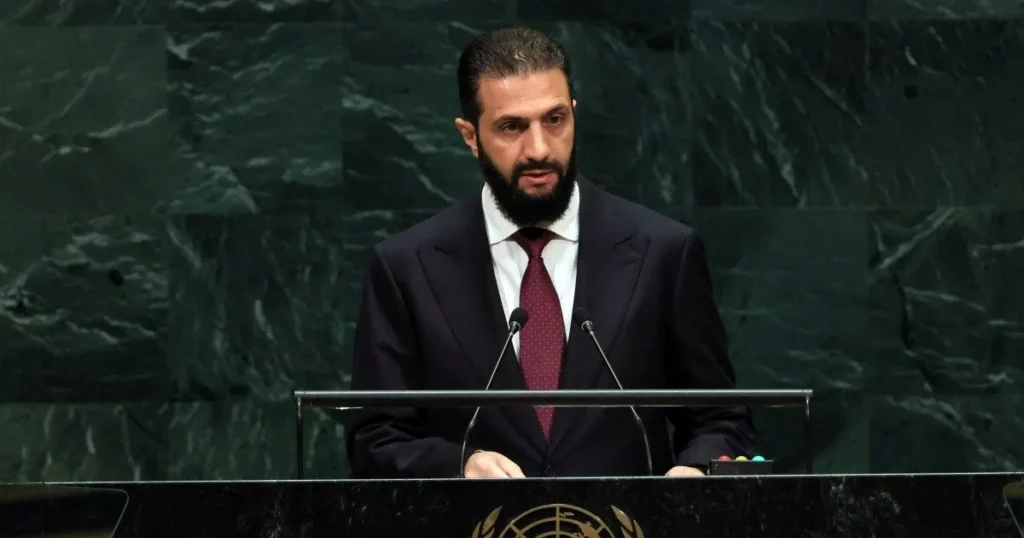
BEIRUT — Syrian President Ahmed al-Sharaa issued a stark warning on Wednesday, asserting that ongoing Israeli military strikes within Syrian borders endanger the delicate post-war recovery efforts and threaten to destabilize the region. Speaking to a delegation of foreign diplomats and journalists, al-Sharaa emphasized that Syria’s sovereignty is non-negotiable and that the country cannot achieve lasting peace while its territorial integrity remains compromised.
The President’s remarks come amid a series of Israeli air raids targeting military infrastructure in the southern Golan Heights and the Quneitra buffer zone. According to Syrian state media, the strikes have damaged several government buildings and communication hubs, prompting a sharp diplomatic response from Damascus. Al-Sharaa stated that these actions are inconsistent with international law and undermine the trust necessary for any future diplomatic engagement.
Diplomatic Stance on Sovereignty
Al-Sharaa reiterated that the Golan Heights remain Syrian territory under international law, despite Israel’s long-standing occupation of the plateau. “The Golan Heights are Syrian soil, and Israel must withdraw its forces from all occupied areas,” al-Sharaa said, according to a statement released by the Syrian presidency. He further noted that Syria’s foreign policy is guided by the principle of mutual respect and non-interference, but that this principle is currently being tested by unilateral military actions.
In a separate interview with Middle East Eye, al-Sharaa clarified that Syria is not seeking confrontation but is committed to defending its citizens and its land. “There will be no peace with Israel if the rights of Syrians are usurped,” he stated. The President emphasized that Syria’s door remains open for dialogue, provided that such discussions are based on the recognition of Syrian sovereignty and the cessation of hostile acts.
Regional Implications and Security Concerns
Analysts note that al-Sharaa’s hardline stance reflects a broader shift in Syrian foreign policy since the change of government. The new administration has sought to distance itself from previous alliances while maintaining a firm position on territorial disputes. The Israeli military has not issued a detailed public response to al-Sharaa’s specific warnings, though Israeli officials have previously stated that operations in the region are necessary to prevent the buildup of hostile forces near the border.
The tension has raised concerns among regional neighbors, including Jordan and Lebanon, who fear that escalating hostilities could spill over into their own territories. Jordan’s Foreign Ministry issued a statement calling for restraint and urging both sides to engage in diplomatic channels to de-escalate the situation. Similarly, Lebanese officials expressed concern over the potential for a wider conflict, given the proximity of the border and the presence of various armed groups in the region.
Al-Sharaa’s comments also address the internal security challenges facing Syria. The President acknowledged that the country is still in the process of rebuilding its institutions and economy after years of civil war. He warned that external interference, particularly through military strikes, could derail these efforts and prolong the suffering of the Syrian people. “Our priority is the reconstruction of Syria and the restoration of normal life for our citizens,” al-Sharaa said. “We cannot achieve this while our borders are under constant threat.”
International Reaction
The United Nations has called for calm and urged all parties to respect international law and the sovereignty of states. A spokesperson for the UN Secretary-General stated that the organization is closely monitoring the situation and is working with regional partners to facilitate dialogue. Western diplomats in Damascus have reportedly engaged with Syrian officials to understand their perspective and to explore avenues for de-escalation. However, sources indicate that progress has been slow, with both sides maintaining firm positions on key issues such as the status of the Golan Heights and the presence of foreign military forces.
Al-Sharaa’s warnings mark a significant moment in Syria’s post-war trajectory, as the country seeks to establish its place in the international community while navigating complex security challenges. The coming weeks are expected to be critical, with further diplomatic efforts likely to focus on establishing a framework for security cooperation and the resolution of territorial disputes. The outcome of these efforts will determine whether Syria can move toward stability or face renewed conflict.
Primary Sources & Official Records
- Syria’s al-Sharaa warns Israeli attacks endanger delicate post
- No peace with Israel ‘if rights of Syrians are usurped’, Sharaa says – Middle East Eye
- Syria’s al-Sharaa: Golan Heights are Syrian territory, Israel must withdraw – Haaretz
- Ahmed al-Sharaa: October 7 cannot dictate Israel’s Syria policy – The Jerusalem Post