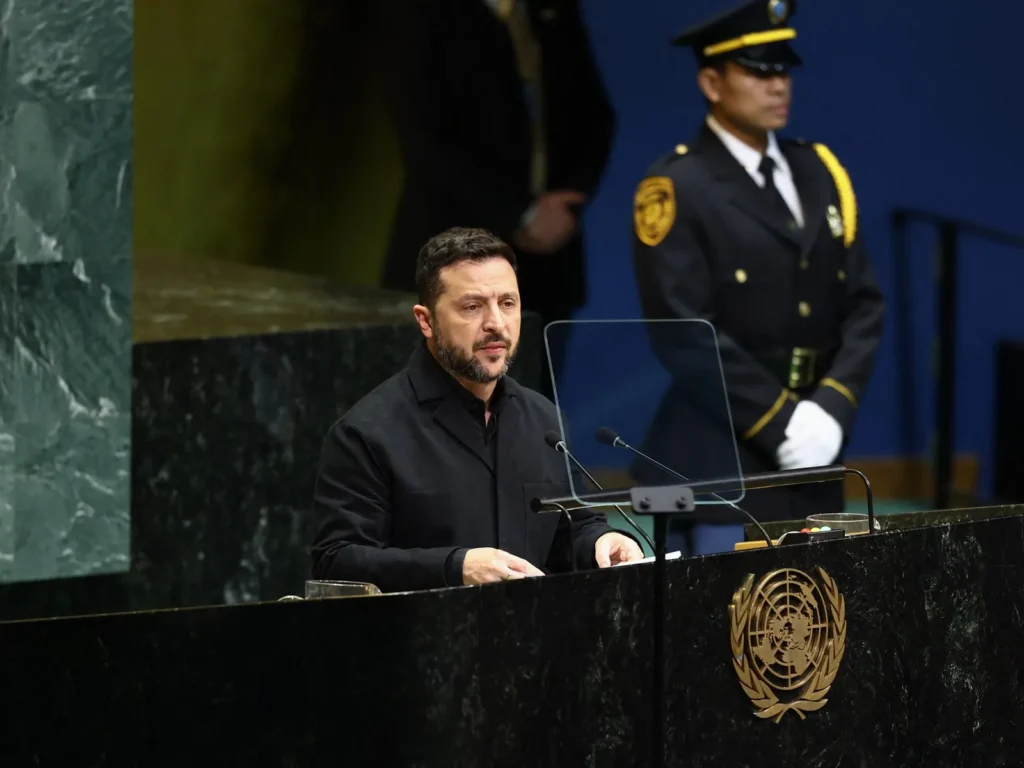
NEW YORK — Ukrainian President Volodymyr Zelenskyy called on the international community to maintain and intensify pressure on Russia to end what he described as “Putin’s crazy war,” addressing the United Nations General Assembly on Wednesday. Speaking from the podium at the UN headquarters, Zelenskyy emphasized that diplomatic isolation and economic sanctions remain the primary levers for compelling Moscow to cease hostilities, warning that any relaxation of these measures would only embolden the Kremlin.
The address, delivered during the high-level week of the 81st session of the General Assembly, focused heavily on the economic dimensions of the conflict. Zelenskyy argued that Russia’s war machine is sustained by continued access to global energy markets and financial systems. He specifically urged major economies, including India and China, to halt energy trade with Russia, stating that such transactions directly fund military operations on the front lines. The President noted that while Western nations have imposed comprehensive sanctions, the effectiveness of these measures is diluted when non-aligned nations continue to purchase Russian oil and gas at discounted rates.
Economic Leverage and Global Trade
Zelenskyy’s remarks align with a broader Western strategy to decouple the Russian economy from global markets. Since the full-scale invasion of Ukraine in February 2022, the United States, the European Union, and their allies have implemented multiple packages of sanctions targeting Russia’s banking sector, energy exports, and defense industry. However, Moscow has adapted by rerouting oil exports through third-party countries and utilizing a shadow fleet of tankers to bypass price caps. The Ukrainian President stated that this resilience underscores the need for a unified global front, where no major consumer of Russian energy remains outside the sanctions framework.
The call for sustained pressure was framed not merely as a geopolitical stance but as a humanitarian imperative. Zelenskyy cited the ongoing destruction of Ukrainian infrastructure, including power grids and water systems, as evidence that the war’s impact is spreading beyond the battlefield. He urged member states to prioritize the reconstruction of Ukraine and to ensure that any future peace negotiations are conducted from a position of strength, with clear accountability for war crimes and reparations.
Diplomatic Context and Reactions
The speech comes at a critical juncture in the conflict, with diplomatic efforts to secure a ceasefire or negotiated settlement facing significant hurdles. Western officials have repeatedly stated that Ukraine must have a seat at any peace table, while Russia has maintained that its security concerns, including NATO expansion, must be addressed. Zelenskyy rejected the premise that Ukraine’s sovereignty is negotiable, reiterating that the country’s territorial integrity is non-negotiable. He warned that the international community must not allow the war to become a frozen conflict, which he argued would only serve to prolong suffering and destabilize the region.
Analysts note that Zelenskyy’s direct appeal to non-Western powers is a strategic shift, acknowledging that the outcome of the war depends on the economic decisions of major Asian economies. India, one of the largest buyers of Russian crude oil, has maintained a neutral stance, emphasizing the importance of dialogue and avoiding actions that could exacerbate the conflict. China, a key ally of Russia, has similarly called for a peaceful resolution without explicitly condemning Moscow’s military actions. Zelenskyy’s speech aimed to bridge this gap by highlighting the global economic costs of inaction, including inflationary pressures and supply chain disruptions linked to the war.
The UN General Assembly session has also seen discussions on other global conflicts and the role of artificial intelligence in warfare, but Zelenskyy’s address dominated the diplomatic agenda. His presence in New York, despite ongoing security threats, was viewed as a symbolic gesture of Ukraine’s determination to remain at the center of international diplomacy. The President concluded by urging member states to translate words into action, stating that the time for hesitation has passed and that the world must stand united against aggression.