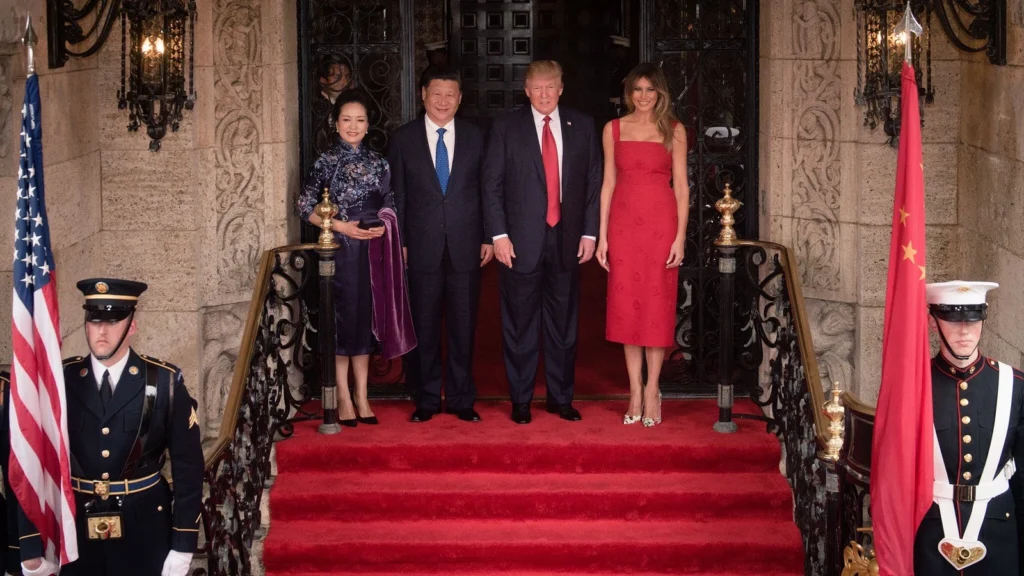
WASHINGTON — U.S. President Donald Trump welcomed Chinese President Xi Jinping to the White House on Wednesday with a full display of state honors, including a red carpet arrival, a military flyover, and a lavish banquet, in a high-stakes diplomatic engagement aimed at stabilizing relations between the world’s two largest economies.
The ceremony, which took place on the South Lawn of the White House, featured a formal military flypast by U.S. Air Force jets, a standard protocol for visiting heads of state but one that carries significant symbolic weight given the current geopolitical climate. The two leaders were seen shaking hands and exchanging pleasantries before proceeding to the Rose Garden for a joint press conference, where they addressed the complex issues of trade, technology, and regional security.
Despite the ceremonial warmth, the backdrop of the visit is marked by significant tensions. U.S.-China relations have been strained in recent months over trade imbalances, intellectual property disputes, and strategic competition in the Indo-Pacific region. Analysts note that the elaborate welcome signals a desire from both sides to de-escalate friction and open channels for dialogue, even as structural disagreements persist.
During the joint press conference, President Trump emphasized the importance of a stable relationship, stating that the two nations have much to gain from cooperation. President Xi, in turn, highlighted the need for mutual respect and the avoidance of conflict, urging both sides to focus on areas of common interest such as climate change and global economic stability.
The visit includes a series of bilateral meetings between senior officials from both countries, covering topics ranging from semiconductor supply chains to agricultural exports. A key focus of the talks is the potential for a new trade framework that could address existing tariffs and promote fair competition. Both delegations are expected to hold closed-door sessions to discuss sensitive security matters, including cyber operations and military communications.
The military flyover, which involved a formation of F-22 Raptor and B-2 Spirit stealth bombers, was a notable display of U.S. military capability. While such displays are routine for state visits, their inclusion in this context has been interpreted by some observers as a dual message of welcome and deterrence. The U.S. Department of Defense confirmed that the flyover was a standard part of the state visit protocol and did not carry additional strategic implications beyond ceremonial honor.
Following the morning ceremonies, the two leaders attended a lavish banquet hosted by the Trump administration. The event, held in the East Room, featured a menu designed to reflect both American and Chinese culinary traditions. Diplomatic sources indicated that the banquet was intended to foster a more personal rapport between the leaders, who have had limited face-to-face interactions in recent years due to the pandemic and subsequent diplomatic pauses.
The visit comes at a critical juncture for global markets, which have been volatile amid concerns over a potential trade war. Investors are closely watching the outcomes of the talks for signals on tariff policies and technology restrictions. The U.S. stock market saw a modest rise in pre-market trading on Wednesday, reflecting cautious optimism that the summit could yield tangible progress.
Chinese state media described the visit as a success, highlighting the warm reception and the constructive nature of the discussions. U.S. officials, while maintaining a measured tone, acknowledged the importance of the engagement and expressed hope for continued dialogue. The White House stated that the visit was a testament to the commitment of both leaders to manage their differences responsibly and to seek areas of cooperation that benefit their respective peoples.
As the two leaders concluded their day of meetings, they agreed to maintain close contact and to schedule further consultations in the coming months. The visit marks a significant step in re-engaging diplomatic channels that had been strained by recent geopolitical developments. While challenges remain, the ceremonial welcome and the substantive discussions suggest a shared interest in preventing a deeper rift between the two powers.